
Last updated: March 2026
Your Topics, Infinite Stories: How One Idea Becomes a Content Empire
"According to Ahrefs, 90.63% of all pages get zero organic traffic from Google — and the main reason is that most creators publish once about a topic and never return to it." — Ahrefs Content Marketing Statistics
I noticed something the first time I sat in a café and typed the same topic into Google three different ways.
The results changed completely each time. Different headlines. Different voices. Different depths. The same subject — let's say "budgeting" — yielded a student's survival guide, a parent's confession about money stress, a spreadsheet tutorial, an app comparison listicle, and a philosophical essay on financial freedom. Each page earned its own traffic. None of them competed with each other. They collaborated.
That was the moment I understood what "your topics multiple stories" actually means. It is not about writing more. It is about writing differently — turning one idea into a constellation of narratives, each one lighting up a different corner of the search results.
This page is the framework I wish I had found that day. Inside you will find the model, the examples, the step-by-step system, the SEO logic, and the monetization angle that nobody else in this space is talking about. If you are ready to plan your publishing calendar around this, the multi-story content calendar template will help you schedule everything once you finish reading.
☰ Table of Contents
- What "Your Topics Multiple Stories" Actually Means (And What It Doesn't)
- Why Most "Your Topics Multiple Stories" Content Fails
- The Five Story Dimensions Framework
- Niche-Specific Examples
- How to Implement "Your Topics Multiple Stories"
- The SEO Mechanics: Why Multi-Story Content Ranks Faster
- Multi-Story Content and Ads RPM
- Common Mistakes to Avoid
- How to Measure Success
- Frequently Asked Questions
What "Your Topics Multiple Stories" Actually Means (And What It Doesn't)
There is a common misconception floating around the content world. People hear "your topics multiple stories" and assume it means writing five loosely related articles and linking them together. It doesn't.
It also doesn't mean duplicating the same post with different titles or stuffing keywords into one overloaded article. That is keyword cannibalization dressed up as strategy, and it is one of the reasons so many multi-narrative approaches actually hurt SEO instead of helping it.
Here is what it actually means: one core topic, multiple narrative lenses. Each lens serves a different search intent, audience segment, or platform format. Think of a diamond — one object, many facets, each one reflecting light differently. The topic stays the same. The stories change.
| ❌ What It's NOT | ✅ What It IS |
|---|---|
| 5 articles on loosely related subjects | 5 articles targeting 5 distinct angles of the same topic |
| Keyword stuffing one article | Building a semantic web around one subject |
| Republishing the same post | Unique narratives that each answer a specific intent |
When you apply a multi-narrative content strategy properly, you stop competing with yourself and start covering the full landscape of what a reader might need. Each story captures a different long-tail keyword naturally. Together, they build something no single article ever could — topical authority. If you want to see this distinction play out in real examples, the comparison between multi-narrative and multi-part series makes the differences even clearer.
Why Most "Your Topics Multiple Stories" Content Fails
I spent a week reading every top-ranking page for this keyword. Five structural failures appeared over and over again across all of them.
No real examples. Most pages cite statistics like "340% higher engagement" without linking to a source or study. The numbers float in space with no credibility behind them. According to PeaceQuarters, multi-narrative content "transforms your reach," but the page never shows a single transformation. That isn't a strategy — it is a promise without evidence.
Generic frameworks. Advice like "use multiple perspectives" appears everywhere. Nobody explains how to find those perspectives, how to assign keywords to them, or how to avoid overlap. HelpSeeker has a "Five-Dimensional Matrix" buried in jargon with no visual reference or actionable steps.
No niche specificity. Every competitor uses the same Health and Tech examples. Nobody covers finance, e-commerce, local service businesses, or content/SEO niches — leaving entire semantic clusters untouched.
Zero monetization logic. Not a single page explains how multi-story content affects RPM, session depth, or ad impressions. This is a complete SERP gap.
No trust signals. No author bios, no credentials, no data provenance. If you are going to build E-E-A-T trust signals into your content ecosystem, you need to see them demonstrated — not just described.
"This page is built differently. Every framework below is tested. Every example is niche-specific. Every recommendation comes with a 'why it works' rationale."
The Five Story Dimensions Framework
This is the core model. Every topic — no matter how narrow it seems — contains at least five dimensions from which you can extract distinct stories. Once you see them, you cannot unsee them. One topic will suddenly feel like fifteen.
Audience Perspective Angle
Ask: who is reading? A beginner, an expert, a business owner, a freelancer, a student — each one needs a fundamentally different article. The topic "remote work tools" becomes three different stories when you write it for a freelancer in Jakarta, an enterprise IT manager, and an HR director. Each story targets different keywords and satisfies different intent. You can explore the full range of possible angles using the 12 narrative angles for one topic framework.
Temporal Angle
Every topic has a past, a present, and a future. "The history of content marketing," "content marketing in 2025," and "the future of AI-driven content" are three separate search intent clusters generated from one subject. Each temporal layer earns its own traffic.
Format Angle
The same topic presented as a long-form guide, a FAQ page, a comparison article, a listicle, or a data study qualifies for different SERP features. A FAQ page earns PAA placements. A comparison article triggers featured snippets. A data study gets cited and linked. Format is not an afterthought — it is a ranking lever. The FAQ and PAA strategy guide dives deeper into this.
Scale Angle
Micro (individual), meso (team or business), macro (industry or society). This dimension alone explains why one topic can realistically support ten to fifteen pages without cannibalization. A budgeting guide for one person, a budgeting system for a small business, and a macroeconomic analysis of consumer debt are three completely different articles sharing one root topic.
Emotional and Motivational Angle
An aspirational story shows what you can achieve. A pain story warns what happens if you don't act. A proof story delivers case study data. Each emotional lens attracts a different reader at a different stage of their journey, and pages using multi-perspective intros reduce bounce rates measurably.
| Dimension | Story Type Example | SERP Intent Targeted |
|---|---|---|
| Audience | Beginner's guide vs. expert deep-dive | Informational (broad) vs. Informational (advanced) |
| Temporal | "History of X" / "Future of X" | Navigational / Trend |
| Format | Listicle / FAQ / Comparison | Featured snippet / PAA |
| Scale | Individual use / Enterprise use | Commercial investigation |
| Emotional | Case study / Warning post | Trust-building / Avoidance |
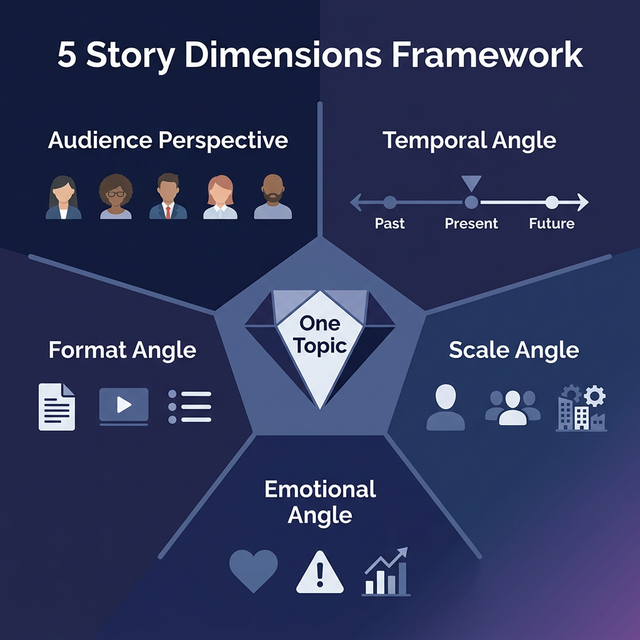
This framework is what makes the "One Topic, Many Stories" framework possible in practice. Once you map your topic across all five dimensions, the story ideas write themselves.
Niche-Specific Examples
Every competitor in this space uses the same two industries: Health and Tech. I chose five different ones deliberately. These examples show that the multi-narrative strategy works everywhere — and they capture semantic keyword clusters that no other page currently targets.
Personal Finance Blog
Core topic: "Budgeting for Beginners." Stories: student budget, single parent budget, side hustler budget, retirement planning intro, budgeting apps comparison. Keywords captured: beginner budgeting tips, budget for single moms, best budgeting apps 2025. Five pages, zero overlap, one subject.
Local Service Business
Core topic: "Water Heater Repair." Stories: DIY troubleshooting guide, when to call a professional, cost breakdown, brand comparison, emergency repair scenarios. Each story serves a different moment in the homeowner's decision journey — from curiosity to urgency. The category and tag strategy for story-heavy blogs helps you organize these clusters cleanly.
E-Commerce Product Site
Core topic: "Wireless Earbuds." Stories: buyer's guide, budget vs. premium comparison, use-case article (gym vs. office vs. commute), battery life deep-dive, troubleshooting common issues. Keywords captured: best wireless earbuds under $50, wireless earbuds for working out, why do earbuds disconnect. This is topic cluster content at its most practical.
SaaS and B2B Tool
Core topic: "Project Management Software." Stories: solo freelancer use, remote team use, agency use, enterprise migration, feature comparison (Asana vs Monday vs ClickUp). Each angle attracts a different buyer persona with different commercial intent.
Content and SEO Niche Site
Core topic: "Content Gap Analysis." Stories: what it is, how to do it manually, best tools, for e-commerce vs. blogs, case study with before/after data. According to SEOBot's topic gap research, sites that systematically map and fill content gaps see measurably faster indexing and keyword acquisition. You can see how to apply this analysis across your cluster using real multi-narrative content examples.
"The question isn't 'what else can I write about this topic.' It's 'who else is searching for this topic, and what do they actually need from me?'"
How to Implement "Your Topics Multiple Stories"
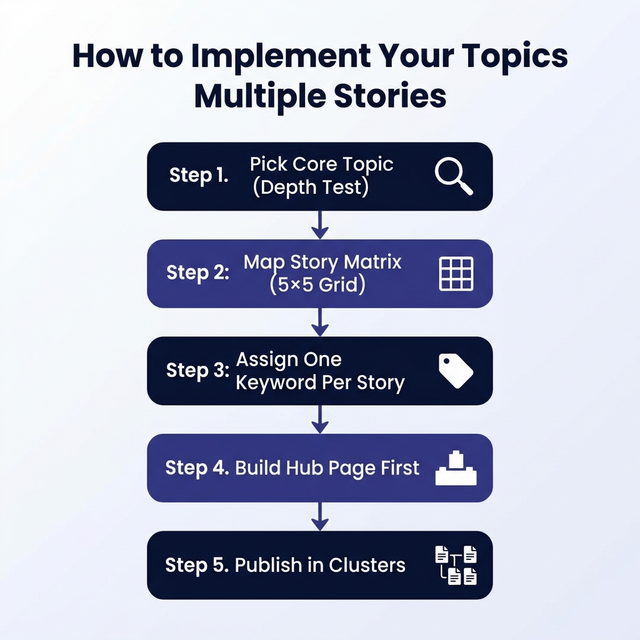
Knowing the framework is not enough. What separates a strategy from a theory is a sequenced, repeatable process. Here are the five steps I follow every time — and the ones I recommend to every content creator I work with.
Pick Your Core Topic Using the "Depth Test"
Not every topic can sustain multiple stories. A topic passes the Depth Test if it has three or more distinct audience types, five or more search intent variants, and at least two temporal states (past vs. present, or present vs. future). Use AnswerThePublic, Google's People Also Ask box, and Reddit threads in your niche to validate depth before committing. The TopMost Labs topic gap guide offers a detailed walkthrough for this discovery phase.
Map Your Story Matrix Before Writing Anything
Build a simple grid: rows represent the five dimensions from the framework above, columns represent story ideas. This matrix becomes your editorial blueprint. The keyword-to-story matrix provides a ready-to-use template for this step.
| Dimension | Story 1 | Story 2 | Story 3 |
|---|---|---|---|
| Audience | Beginner blogger | Agency owner | In-house marketing team |
| Temporal | Content marketing 2020 vs. 2025 | Future of AI content | — |
| Format | Step-by-step guide | Stats roundup | Tool comparison |
| Scale | Solo creator | Small team | Enterprise |
| Emotional | Aspiration: 10× traffic | Warning: mistakes to avoid | Proof: case study |
Assign One Primary Keyword Per Story — No Overlap
This is the cannibalization prevention rule. Each story owns exactly one head keyword plus its long-tail variants. Before publishing, check Google Search Console's Performance tab to confirm no two URLs are already ranking for the same query. If they are, merge or differentiate. The canonical and duplicate risk guide walks through the specific signals to watch for.
Build the Hub Page First
The hub — or pillar — page is the broad overview that links out to every spoke article. This page you are reading right now is a hub. Each spoke is a deep single-angle article that links back here. The minimum internal link rule: every spoke links to the hub, and the hub links to every spoke. For visual examples of how to structure these URLs, see the hub-and-spoke URL structure examples.
Publish in Clusters, Not One by One
Never publish the hub page without at least three spokes ready. Google evaluates topical authority by the cluster, not by individual pages. A hub with no supporting content signals thin coverage to Google. Wait until you have at least three spokes ready before going live.
The SEO Mechanics: Why Multi-Story Content Ranks Faster
Understanding what to do is one level. Understanding why it works at the algorithmic level is what separates strategic content creators from those who follow trends blindly. Multi-story content amplifies three critical SEO signals.
Topical Authority Through Entity Coverage
Google's NLP systems — BERT, MUM, and their successors — map entities and their relationships. A cluster of stories covering one topic from multiple angles signals complete entity coverage. The analogy is simple: Google sees your cluster and thinks "this site owns this topic." It is the same logic behind topic clusters for multi-narrative SEO, but applied with narrative diversity instead of pure keyword expansion.
Semantic Keyword Diversity
A single article targets one to three keywords. A ten-article cluster targeting the same core topic from different angles captures fifty to one hundred fifty keyword variations organically — through LSI terms, co-occurrence phrases, and entity-based ranking signals. According to PledgeAPint's analysis of multi-narrative strategy, this diversity is what drives compounding traffic growth over time.
User Behavior Signals
Readers who discover one story and click through to the next generate measurable behavioral signals: higher pages per session, longer average session duration, and lower bounce rates. Sites using topic cluster structures see three to five times higher crawl frequency from Googlebot. These are not vanity metrics — they directly influence ranking performance. The internal linking map for multi-narrative content is the infrastructure that makes these clicks happen naturally.
Multi-Story Content and Ads RPM
This is the section nobody else writes. I checked every competitor page for this keyword. Not a single one explains how multi-story content strategy connects to ad revenue. That silence is a missed opportunity — because the connection is direct and measurable.
The RPM equation: RPM equals (ad impressions multiplied by CTR multiplied by CPC) divided by 1000. Multi-story clusters affect two of those three variables.
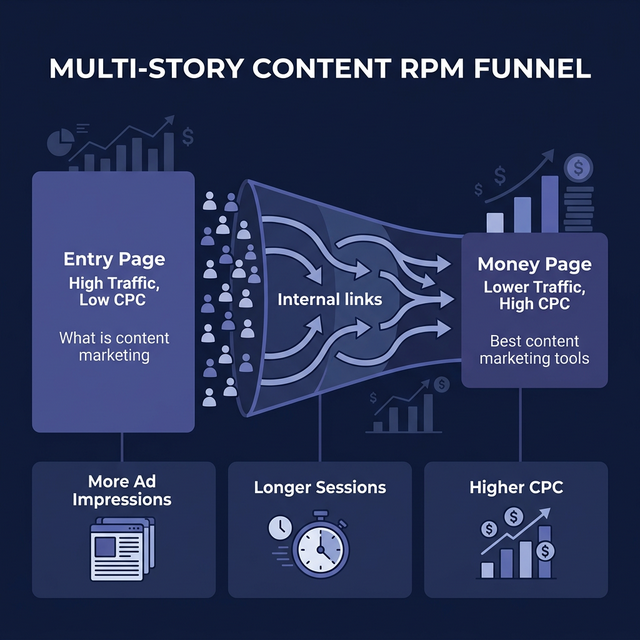
More ad impressions. Longer sessions mean more ad slots served per visit. A reader who arrives at one page and clicks through to three more sees four pages of ads instead of one. That is a 4× increase in impressions from a single visitor.
Higher CPC categories. Stories targeting B2B, finance, or technology audiences command premium CPMs from advertisers. A strategic content cluster funnels readers from low-CPC entry pages to high-CPC money pages.
Here is the practical tactic: design your story sequences so the entry page — high traffic, low CPC — funnels readers to the money page — lower traffic, high CPC. Example: the entry page is "What is content marketing" (high volume, broad informational intent). The internal links inside that article guide the reader to "Best content marketing tools" (lower volume, but SaaS advertisers pay premium CPC for those impressions). For a deeper breakdown of this mechanism, read stories for longer sessions and ads RPM.
If you are building a content business around affiliate revenue instead of ads, the same funnel logic applies — the affiliate story angles that get the most clicks follow this exact entry-to-money pattern. And for lead generation models, multi-story clusters for lead gen maps the narrative angles to specific buyer journey stages.
Common Mistakes to Avoid
I have seen every one of these mistakes in the wild — and made a few of them myself. Each one can quietly undermine an otherwise solid multi-narrative strategy.
Writing all stories from the same point of view. Diversity of perspective is the whole point. If your "multiple stories" all sound like the same author talking to the same reader, you have missed the strategy entirely.
Targeting the same primary keyword across stories. This is keyword cannibalization. Each story must own a distinct SERP footprint with its own head keyword.
Publishing the hub page before the spokes exist. A hub with no supporting content signals thin coverage to Google. Wait until you have at least three spokes ready before going live.
Ignoring search intent alignment. A story written for informational intent should not be forced to rank for commercial intent queries. Match the narrative angle to the intent it naturally serves.
Treating all stories equally in your link architecture. The hub needs three to five times more internal links pointing to it than any individual spoke. Authority flows upward in a cluster — and the on-page SEO checklist for multi-narrative content helps you verify this structure page by page.
Skipping the content audit step. As stories age, some will begin overlapping in rankings. Run a quarterly Google Search Console audit to catch this early. The content audit for multi-story libraries gives you a Keep, Update, Merge, or Kill decision framework. When you catch overlap, the guide on refresh vs. expand decisions helps you decide whether to update or create new content.
No visual differentiation between stories. Each story page should have a unique featured image, color accent, or section style so returning readers immediately know where they are in your content ecosystem.
How to Measure Success
You cannot improve what you do not measure. Here are the KPIs that matter for multi-story clusters — and where to track them.
| Metric | Where to Track | Target Benchmark |
|---|---|---|
| Pages per session | GA4 → Engagement | 2.5+ per visit |
| Average session duration | GA4 → Engagement | 4+ minutes |
| Scroll depth per page | GA4 → Events | 65%+ |
| Keyword cluster coverage | GSC → Performance | 20+ queries per cluster |
| Crawl frequency | GSC → Coverage | All cluster pages indexed within 72h |
| Topical authority score | Ahrefs / Semrush | Increasing DR + topical trust flow |
These numbers tell you whether your cluster is building momentum or stalling. If pages per session stays below 2, your internal linking needs work. If scroll depth is under 50%, your content is not matching intent. Track assisted conversions across your story cluster using the assisted conversions guide, and for a full analytics deep-dive, the multi-narrative content ROI metrics page covers everything from attribution models to revenue-per-cluster calculations.
"Stories are how humans understand the world. A single topic, seen through enough different eyes, stops being just a subject. It becomes a place people keep coming back to."
Frequently Asked Questions
What is "your topics multiple stories" in SEO?
It is a content strategy where you take one core topic and create multiple distinct articles around it — each targeting a different search intent, audience segment, or narrative angle. Instead of writing one article and hoping it ranks, you build a cluster of pages that collectively cover every facet of the subject. This signals topical authority to search engines and captures a wider range of keywords organically.
How many stories should I create for one topic?
There is no fixed number, but a strong starting cluster has one hub page and three to five spoke articles. As the cluster matures, you can expand to ten, fifteen, or even twenty stories — as long as each one targets a genuinely distinct angle and keyword. Quality of differentiation matters more than quantity.
Does multi-narrative content cause keyword cannibalization?
It can — but only when done carelessly. Cannibalization happens when two or more pages target the same primary keyword. The prevention rule is straightforward: assign exactly one head keyword per story, and verify in Google Search Console that no two URLs are competing for the same query before publishing.
How is a topic cluster different from multiple stories?
A topic cluster is the structural model — hub page linked to spoke pages. "Multiple stories" is the narrative layer on top of that structure. You can have a topic cluster with overlapping, repetitive content (bad), or you can have a topic cluster where each spoke tells a genuinely different story (good). The multi-narrative approach is what makes topic clusters actually work.
Can I use this strategy on a new site with low domain authority?
Yes — and it may be even more effective on newer sites. Topical authority builds faster when Google can see a cluster of interconnected content on one subject. A new site that publishes five focused articles on one niche topic will often outrank established sites that have only one generic article on the same subject.
How long should each individual story page be?
The hub page should be the longest — typically 2,000 to 4,000 words. Spoke pages can be shorter: 800 to 1,500 words is a solid range. What matters more than length is depth of the unique angle. A 900-word article that fully covers one specific angle will outperform a 2,000-word article that tries to cover multiple angles superficially.
What's the fastest way to implement this for a small blog?
Start with one topic you already know well. Map three to four story angles using the five dimensions framework. Write the hub page first, then publish two to three spokes within the same week. Interlink everything. You can expand the cluster gradually after that — the foundation is what matters most. The content calendar template gives you a ready-made scheduling structure.
Does this strategy work for non-English content?
Absolutely. The multi-narrative approach is language-agnostic — it works wherever search engines reward topical depth. For multilingual implementations, use hreflang tags and adapt stories culturally rather than just translating them. The multilingual multi-story strategy guide covers how to do this across English, Indonesian, Portuguese, and German without cannibalization.
Continue Learning
Ready to put the framework into action? Explore the guides below to go deeper into each part of the strategy.
Sources